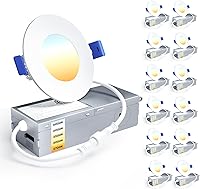
Recessed Light Sizes: 3, 4, 5 and 6 Inch Explained
Choose a recessed light by matching its cutout to your ceiling and its light output to the room. Small 3 or 4 inch fixtures suit focused light, while 5 or 6 inch options cover more area.
On this page (7 sections)
- What do recessed lighting sizes mean?
- How do 3, 4, 5 and 6 inch lights differ?
- Are 5 and 6 inch recessed lights better for general lighting?
- Does a bigger recessed light make a room brighter?
- How do you choose the right size for an existing ceiling?
- How does size affect spacing and room coverage?
- Which recessed light size should you choose?
Choose a recessed light by matching its cutout to your ceiling and its light output to the room. A 3 or 4 inch fixture can work for focused light, while a 5 or 6 inch option can cover more area.
The diameter alone doesn't tell you how bright a light will be. Check the lumen output, plan where fixtures will go, and confirm whether the light fits an existing can or needs a new opening.
What do recessed lighting sizes mean?
Recessed lighting sizes usually refer to the nominal diameter of the light or housing. The exact cutout can be smaller than the visible trim, and its required size depends on the model.
Measure an existing opening across the widest point, then check the replacement instructions for its cutout range. For new work, choose the fixture first and use its specified hole size rather than assuming a 4 inch light needs a 4 inch opening.
Canless wafer lights have a thin face and a separate junction box, while can lights use a recessed housing. Learn how these options differ in our guide to slim wafer lights.
How do 3, 4, 5 and 6 inch lights differ?
Smaller lights have a compact face, while larger lights can provide more light from each fixture. The right choice depends on the room, desired spread, available ceiling space, and the product's lumen rating.
| Nominal size | A common use | What to check |
|---|---|---|
| 3 inch | Accent or focused light | Whether the smaller beam covers the intended area |
| 4 inch | Task or general light in smaller zones | Lumens and spacing |
| 5 inch | General light or replacing some existing fixtures | Can or cutout compatibility |
| 6 inch | Broader general lighting | Cutout, output, and ceiling layout |
These are starting points, not fixed rules. A 3 inch light with strong output may be brighter than a larger, lower-output fixture, so compare lumens and beam spread as well as diameter.
Are 3 inch recessed lights too small?
A 3 inch light isn't automatically too small; it can suit a focused task or accent area. It may take more fixtures to light a whole room evenly, depending on output and spacing.
The Amico 3 inch canless wafer is rated at 500 lumens and uses 7 watts. Its compact size may fit a plan with several light points, but map the layout before choosing a pack.
Use a small fixture when you want the ceiling openings to stay visually modest or need light over a specific area. Don't select it only because it looks smaller; confirm that its output and beam angle meet the room's needs.
Is a 4 inch recessed light a good middle choice?
A 4 inch light can be a practical middle size for task and general lighting. Compare its lumen output with the number of fixtures and the room's layout.
The Amico 4 inch canless wafer is rated at 800 lumens and 11 watts. It has selectable color temperatures from 2700K to 5000K, so you can choose a warmer or cooler tone during setup.
This fixture is damp rated for humid spaces such as bathrooms, but it isn't meant for direct water spray or standing water. Check local electrical requirements and the installation instructions before placing any light near a shower.
Are 5 and 6 inch recessed lights better for general lighting?
A 5 or 6 inch fixture can be a good fit when you want broader general light or need to cover an existing opening. Check the light's output and the opening dimensions rather than choosing the largest size by default.
The Amico 5/6 inch flat can light has a 7.2 inch diameter and uses an E26 base for retrofit installation.
Its output is 1050 lumens at 12 watts. It has 5 selectable color temperatures from 2700K to 6000K and can be dimmed from 5% to 100% with compatible dimmers, except smart dimmers.
Confirm that the existing housing and opening suit the fixture before buying.
A 6 inch canless wafer is another option when you don't have a can to reuse. The Amico 6 inch model is rated at 1050 lumens and needs a ceiling opening in the 6.2 to 6.6 inch range.
Read our guide to recessed lighting for a living room for room-specific placement ideas. For exact spacing, use the recessed lighting layout guide before cutting holes.
Does a bigger recessed light make a room brighter?
A larger diameter doesn't guarantee a brighter room; lumens and placement matter more. Compare the lumen output of each fixture and estimate how many lights the room needs.
The Amico 3 inch light is rated at 500 lumens, while the 4 inch is rated at 800 lumens. Both the Amico 5/6 inch retrofit and 6 inch canless options are rated at 1050 lumens, so size labels alone don't rank their brightness.
Consider ceiling height, wall color, task areas, and other lights in the room. Our guide to recessed lighting lumens explains how to think about total light output.
How do you choose the right size for an existing ceiling?
Measure the hole and identify the housing before choosing a replacement. A fixture may cover an opening without fitting the can, or fit the can while leaving a gap around the trim.
- Turn off power at the breaker before inspecting the fixture.
- Remove the trim or light according to its instructions.
- Measure the ceiling opening and note the housing type.
- Check the replacement's cutout or can compatibility.
- Confirm the face will cover rough edges or the old opening.
If you're keeping an existing can, compare retrofit models and their base or spring connections. If the opening is too large for the new trim, a smaller nominal size may leave drywall exposed.
How does size affect spacing and room coverage?
Use the fixture's beam spread and lumen output to plan spacing, not a diameter-only rule. A bigger face can still leave dark areas if the lights are spaced too far apart.
Sketch the room and mark seating, counters, work surfaces, and walkways. Place lights where their beams can overlap smoothly, and avoid putting every fixture in a single line if the room's tasks call for different zones.
For a living room, combine ambient coverage with targeted light where people read or gather. In a kitchen, focus on counters and work areas, then check the planned arrangement against the recessed lighting layout guide.
Which recessed light size should you choose?
For accent or focused lighting, consider 3 inches when the light's output suits the task. Choose 4 inches when you want a compact fixture with more output, such as the 800 lumen Amico option.
For general lighting or an existing larger opening, compare 5/6 inch retrofit and 6 inch canless choices. Pick the retrofit light if the existing can is compatible, or the canless model if your ceiling plan calls for a new opening.
Before cutting or ordering, match the opening, fixture type, lumens, and spacing. Then use recessed lighting by room to refine the plan for where the lights will go.
Frequently asked questions
What size recessed lights are best?
The best size depends on the ceiling opening, the light's output, and the job. A 3 or 4 inch fixture can suit focused lighting or a smaller area, while a 5 or 6 inch fixture can spread light across a broader area.
Plan spacing and brightness along with diameter.
Are 4 inch recessed lights bright enough?
A 4 inch recessed light can be bright enough when its lumen output and placement suit the room. The Amico 4 inch canless wafer is rated at 800 lumens.
Calculate the room's total light needs and account for other fixtures before choosing.
Can I replace a 6 inch recessed light with a 4 inch one?
Sometimes, but the new light must fit the ceiling opening or use a compatible housing and trim. A smaller fixture may leave an exposed gap or rough drywall around the opening.
Measure the existing cutout and check the replacement's required hole size before buying.
Do recessed light sizes refer to the trim or the hole?
The size often refers to the nominal fixture or housing size, not the exact cutout. The trim or face can be wider than the opening, and cutout needs vary by model.
Use the installation instructions for the exact hole size and measure the ceiling before cutting.